Stop the tunneling before it ruins your lawn, garden and young trees.
Store-bought repellents and DIY kits might slow voles down for a week, but they won't solve the root problem — and meanwhile the runways keep spreading across your lawn. Voles (often called meadow mice) are outdoor rodents that can quietly destroy turf, gardens and young trees, especially over winter beneath the snow.
Strib Pest Control takes a smarter, safer approach to vole control: eco-conscious treatments that are safe around pets and children, targeted at nesting and feeding areas, and paired with the habitat changes that keep voles from coming back.
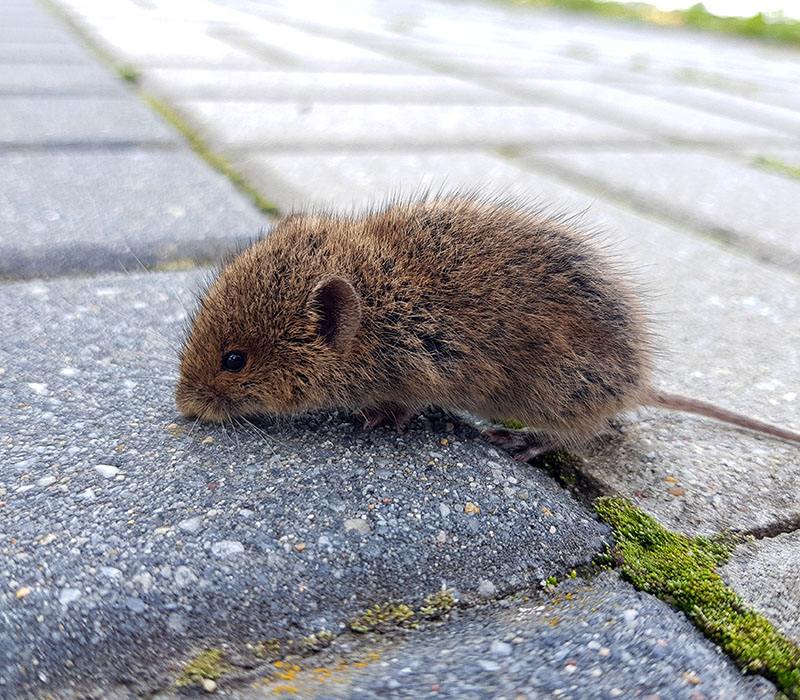
Voles are small, mouse-like rodents with coarse blackish-brown to grayish-brown fur, stocky bodies up to 5 inches long and short 2–3 inch tails. Unlike mice, they live almost entirely outdoors. Watch for:
Homes and businesses adjacent to fields, prairies and unmowed areas face the highest vole pressure.
Voles are harmless to people — the damage is to your landscape investment. A winter of unnoticed feeding can kill young fruit trees and ornamental shrubs outright (a fully girdled trunk cannot recover), hollow out perennial beds and bulb plantings, and leave a lawn crisscrossed with unsightly runways every spring. Populations boom in cycles; in a peak year, a small colony can become an infestation across your whole property in a single season.
Our vole program starts by confirming it's voles (not moles — the treatments differ completely) and mapping the runways and burrow systems. Control combines targeted baiting or trapping along active runways, habitat modification to remove the cover voles depend on, and physical protection — like trunk guards — for vulnerable trees and shrubs. Fall service is especially valuable in Wisconsin: reducing the population before snow cover denies voles their safest feeding season.
Moles leave raised tunnels and volcano-shaped soil mounds and eat grubs and worms. Voles leave surface runways and clean burrow holes and eat plants — roots, bulbs and bark. The wrong treatment does nothing, which is why identification comes first in our service.
If bark is gnawed in a band around the base of the trunk — especially damage discovered as snow melts — that is classic vole girdling. A fully girdled tree usually cannot be saved, so protect remaining trees with trunk guards and address the vole population promptly.
Yes. We use tamper-resistant placements along runways and burrows, out of reach of pets and children, and rely heavily on trapping and habitat modification. Your technician will review every placement with you.
Fast, honest, guaranteed pest control across Madison and Dane County.