Millipede and centipede control that fixes the moisture problem behind the invasion.
Millipedes and centipedes don't spread disease or damage your home — but when dozens of many-legged crawlers start appearing in your basement, bathroom or garage, "harmless" isn't the word that comes to mind. These are moisture pests: they show up indoors when conditions outside push them in, and they concentrate wherever your home is dampest.
Strib Pest Control handles millipede and centipede problems across the Madison area with straightforward, effective treatment — and honest guidance on the moisture conditions that invited them in.
Millipedes are brown, 1 to 1.5 inches long, with rounded worm-like bodies and two pairs of legs per body segment — 30 to 90 legs in all. They move slowly and often curl into a coil when disturbed. Outdoors they live in mulch, compost, leaf litter and flower beds; a swing from moist to dry weather sends them indoors seeking moisture, usually into basements and bathrooms.
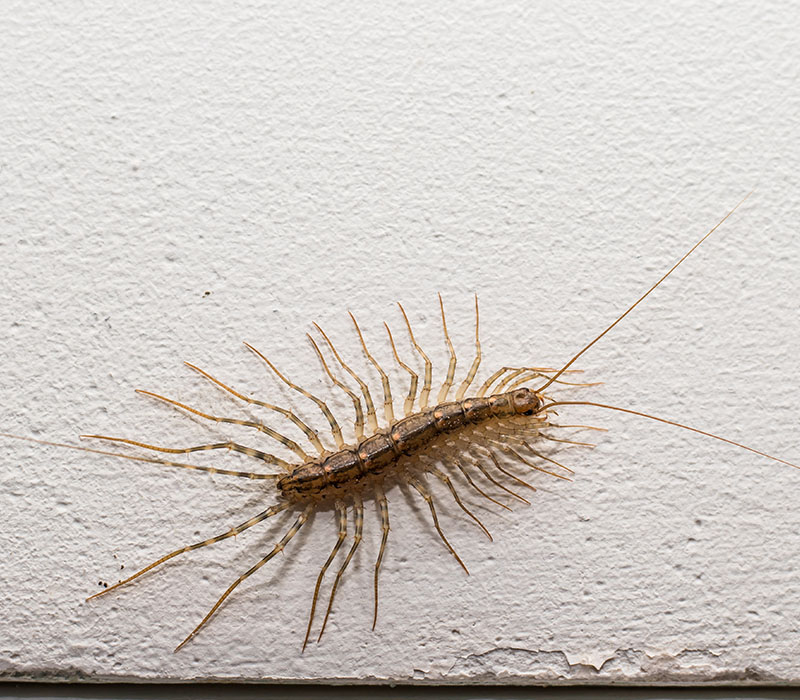
Centipedes (including the common house centipede) are yellowish-brown, 1 to 4 inches, flatter, with one pair of legs per segment — and fast. They hunt other insects at night in damp basements, closets and bathrooms.
Frequent sightings of either, especially after rain or in late fall as temperatures drop, point to a moisture or entry-point problem worth addressing.
Neither pest is a serious threat, but both have defenses worth knowing about. Some millipede species release a fluid containing hydrochloric acid when handled — it can irritate skin and eyes and leaves a persistent odor (wash with soap and water; rubbing alcohol removes the smell). Centipedes can deliver a sting comparable to a bee sting if handled; it's harmless to most people but can cause a reaction in anyone sensitive to insect venom. Children are the most likely to handle them, so heavy indoor populations are worth resolving.
Our millipede and centipede program is exclusion-first: we locate and remove the damp harborage material sustaining them (mulch against the foundation, leaf litter, wet stored items), seal the cracks and gaps they're entering through, and apply targeted, eco-friendly treatments to entry zones and damp interior areas. A house centipede population is also a clue — they eat other insects, so lots of centipedes usually means lots of prey. Our inspection identifies what they're feeding on.
You'll receive a full report of the treatment performed plus specific recommendations for keeping them out.
Weather. Millipedes migrate indoors when their outdoor habitat becomes too dry, too wet or too cold — heavy rain and the first fall cold snaps are peak times in Wisconsin. Your basement is simply the nearest damp refuge. Sealing entry points and drying the space ends the migration.
Not meaningfully. They can sting if handled — similar to a bee sting — but they avoid people and are actually predators of other pests like silverfish and spiders. That said, a large centipede population signals plenty of prey insects and moisture, both worth addressing.
Rarely for long. Millipedes breed outdoors in damp organic material, so unless the harborage and moisture conditions change, new waves keep arriving. Our approach combines targeted treatment with habitat correction and sealing — that combination is what lasts.
Fast, honest, guaranteed pest control across Madison and Dane County.